Rather than delve into the delusion that currently is supposed to oversee this country (and trust me, there’s plenty to call the Tangerine Ignoramus out on simply from this last weekend alone), I’ve decided to start something that will definitely be much more fun. Since college basketball is deciding the 64 teams (OK, 68 teams because of those simply idiotic play in games the NCAA conducts) that will compete for their championship, thought it would be fun to do the same but in a different arena – the genre of hard rock/metal music.
As it is one of my personal fortes, hard rock/metal music is essentially celebrating its 50th Anniversary since the release of Steppenwolf’s “Born to Be Wild,” which contained the lines “Get your motor running/heavy metal thunder.” With this in mind, I’ve put together a compilation of the top 64 hard rock/metal bands from four different eras – the 1960s/70s, the 1980s, the 1990s, and the 2000s/10s – and split them up in accordance with those eras into “regions.” We’ll break down the matchups in each bracket and, with hope, readers will make their own comments and vote on the matchups and perhaps they’ll be some sort of prize at the end – the management here (re: me) is still trying to come up with that prize.
What are the criteria for consideration? First, the band/singer would have to have some sort of longevity to their career – you don’t see many bands or singers that are considered “legendary” if they were only around for a couple of albums (Amy Winehouse is a rare exception, but that’s a discussion for another time). Second, the band/singer would have to have an impact on the genre – did they do something particularly noteworthy or notorious that put them into the annals of the genre’s history, a song or “behavior” that was historic. Third, just how popular were they when they were in existence – a band or singer that was wildly popular with the fans might get some leeway over a critical darling OR vice versa (depending on tastes). Fourth, what accolades did they receive – awards, gold records, and recognition by the industry (Rock & Roll Hall of Fame, hello?) are all under consideration here. Finally, was the band/singer influential on future generations of music – have they helped shape the genre since they have left the sphere?
We talked about the 1960s/70s in Part 1, so now we’re ready to head into what was arguably the most diverse era of hard rock/metal over the past 50 years – the 1980s. From “hair metal” (basically pop-infused hard rock music that could be ballad intensive – something previously unheard of in the genre) to “death metal” and beyond, there were many candidates for this “regions” bracket. I am sure there will be some complaints as to the selections and, if so, please include those when you discuss the matchups in your reply!

Bon Jovi (1) vs. Pantera (16)
As ugly as it is to admit, Bon Jovi was one of the most popular acts of the 1980s. Using enough Aquanet to put his own personal hole in the ozone layer over New Jersey, John Bongiovi – who would become the namesake of the group as Jon Bon Jovi – guitarist Richie Sambora and the rest of the group became the band that was OK with your parents to “rock out” to. They also brought the “power ballad” into its heyday, those songs that brought the girls out to the “rock shows” so the guys would come along.
Pantera, on the other hand, was everything that Bon Jovi wasn’t. Hard core, in your face – sometimes with a fist or a boot – fast and furious, guitarist “Dimebag” Darrell and Phil Anselmo mounted an offensive of thunderous rock that still resonates across the genre. While they were influential to many, they weren’t commercially successful – at least not on the level that Bon Jovi was. It will be an intriguing battle to see who emerges from this clash – but we know who would emerge if it were an actual fight!
Mötley Crüe (8) vs. Skid Row (9)
This is a typical battle of two bands that are closely matched. Strangely enough, though, most people are fans of one and not of the other, with those on the side of Skid Row and front man Sebastian Bach calling their opponents a rip-off of KISS and those taking up the fight for the Crüe and singer Vince Neil and Co. calling Skid Row a Guns ‘N Roses clone. What is true about both bands is they cranked out some memorable music over a short period; Skid Row’s heyday was roughly three years (1989-92), while the Crüe would be relevant for a longer period of time (1981-92). That may be the factor that weighs the winner of this matchup.
Guns ‘N Roses (4) vs. Ratt (13)
It is arguable that Guns ‘N Roses may be the top non-“hair metal” band in the 1980s region, setting them apart from Ratt, who firmly embraced their place in that subgenre. The Gunners captured the rebellious nature of rock and roll that was born in the 1960s and had been lost over the previous 20 years as rock became “corporate.” They also would serve as an inspiration to many bands, with such influence eventually leading to their induction into the Rock & Roll Hall of Fame in 2012. Ratt? Unfortunately, it looks like they ran into the “immovable object” here…but the votes will be what matters.
Iron Maiden (5) vs. Faith No More (12)
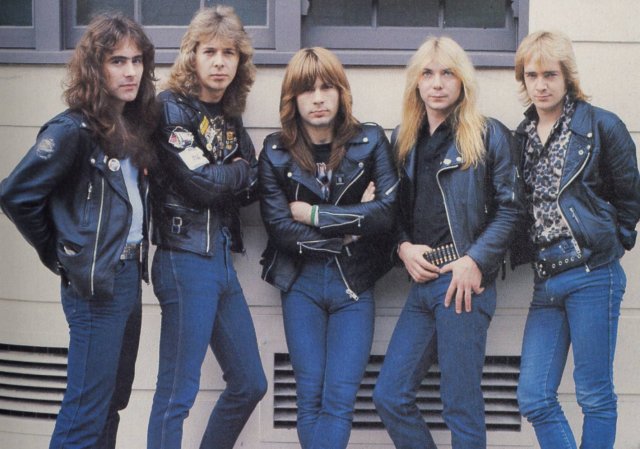
This may look like a mauling, but you’ve got to look deep at the subject. Faith No More were one of the few practitioners of what became known as “rap metal,” or rapping the lyrics instead of singing them, setting them apart in the business and spawning bands that still employ Faith No More’s style today. Iron Maiden was one of the most ferocious bands in the genre who had a great longevity in the business. They also had their impact on future bands, but they weren’t the groundbreakers that Faith No More was in their short time. It will be another tough matchup for the voters to decide.
Metallica (2) vs. Whitesnake (15)
Even considering the ample success that Whitesnake and David Coverdale enjoyed during the 1980s, there’s simply no way that I can see voters taking them over a band that is still going strong today (and if you haven’t heard Metallica’s latest Hardwired…to Self-Destruct, you’re missing out on their best record since the Black Album). Metallica has inspired many a kid to become the next great James Hetfield or Lars Ulrich, consistently powering out epic albums and taking down accolades left and right for their work. They also – whether you agree with them or not – have fought against piracy in the industry, something that all should applaud them for. Whitesnake might have had a chance against anyone else on this list…but not Metallica.
Queensrÿche (7) vs. Anthrax (10)
This is another difficult clash between two talented bands. Queensrÿche arguably introduced the “rock opera” concept into hard rock music in the 80s (OK, don’t remind me of Quadrophenia or other monumental albums) and served as a conduit for politically charged rhetoric (“Empire” delves into the effects of drug trafficking in the inner cities). But of course, their main claim to fame? “Silent Lucidity,” a Pink Floyd-esque power ballad that made the Billboard Magazine Top Ten in 1990.
Anthrax had their own political stances, talking about the plight of Native Americans (“Indians”) and dabbling with rap and classical music in creating their sound. They are one of the few bands to have had success with two different vocalists, Joey Belladonna and John Bush, and they have influenced thrash metal wannabes for over two decades. Do you take style over substance? Or do you award a long, healthy career that has spawned new generations? Tough vote here…
Def Leppard (3) vs. Cinderella (14)
Another matchup between two bands that, at first look, are mirror images. It is only in looking deeper do you see their differences.
The Leppard were a part of the New Wave of British Heavy Metal (NWOBHM) that came out in the late 70s/early 80s, but they weren’t content with staying in that category. They firmly embraced the “hair metal” groove of the decade and became one of the biggest acts of that time. They also demonstrated a great deal of craftsmanship to their records, taking lengthy amounts of time (in some cases, they had to, such as drummer’s Rick Allen’s unfortunate amputation of his arm after an auto accident that forced him to learn how to play drums on a specially created kit) to put out some of the best rock music of the era.
Cinderella was part of that “hair metal” act and even sucked into it a bit by going the power ballad route (“Nobody’s Fool”), but in essence they were a blues band looking for a groove. Singer/guitarist Tom Keifer is a tremendously underrated musician and the rest of the band provided the base for which Keifer could demonstrate his virtuosity. That their era of commercial success was short (1986-1990) was more a fact of the explosion of grunge and rap than any disqualifying factor from the group.

Slayer (6) vs. Megadeth (11)
Man, the 1980s were a tough decade! It’s too bad that one of these bands has to depart in the first round as both, against the right competition, could go deep in this tournament. Slayer was the purveyor of “death metal” with their seminal album Seasons in the Abyss reaching their creative and critical high point. Megadeth, with singer/guitarist Dave Mustaine, have continued performing and releasing highly praised music for almost three decades now, including winning a Grammy Award this year for best metal performance for the title track from their album Dystopia. A knockdown, drag out fight is what to expect here.
That’s it for the second “region” of our tournament. We’ll look at the 1990s and the 2000s/10s (and be thinking of who could be the #1 seeds for those “regions” – would love to hear those opinions) later this week and get into the second round, hopefully by next Monday. Don’t forget to vote by replying here and I will compile the responses – and maybe award a prize once a champion is crowned to a reader!



 Earl Burton