How Far Do We Let Law Enforcement Go in Stopping Criminals?

DallasShooting

The tragedy that occurred last week with the Dallas Police Department’s finest officers – seeing the death of five of their own and the injury to seven, not counting the civilians in the mix – being gunned down by a deranged former Army soldier has left the country stunned. This aftermath came after two shootings by police against black citizens in Louisiana and Minnesota, presumably without provocation or cause (investigation will reveal more…perhaps). As we try to figure out the problems with these prickly issues, there was another issue that raised its head during those frantic hours after gunshots rang through downtown Dallas.

The Dallas police did their job admirably, finally cornering the suspect in a parking garage in that downtown area. Concerned with the possibility that the shooter (and we won’t dignify him by using his name) could shoot and kill more cops and the threats from that shooter that he was ready to use bombs to take out as many people as possible, the Chief of Police for the Dallas PD, David Brown, made the difficult decision to use a remote controlled robot to deliver an explosive device of its own. The device, a Remotec Model F-5, carried a block of C4 weighing less than a pound to the shooter and killed him in the explosion.
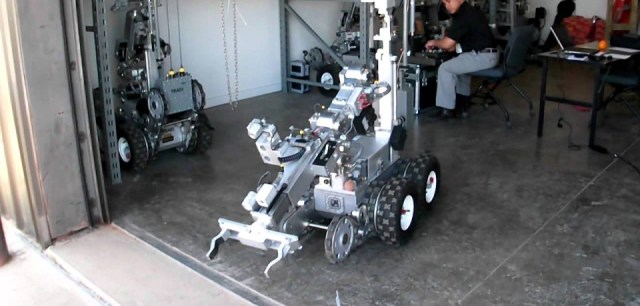
RemotecF5

The Dallas PD issued a statement afterwards, stating that usage of the robot was “a last resort…to deliver an explosion device (sic) to save the lives of officers and citizens.” Chief Brown himself stated that “This wasn’t an ethical decision for me…I’d do it again,” commenting that the standoff with the shooter, the number of officers and civilians already injured and the potential for more casualties required the action. “I would use any tool necessary to save our officer’s lives. I’m not ashamed to say it,” Brown stated.

While the Chief of the Dallas PD made his decision and stands by it, the usage of remote controlled devices by law enforcement is something that has to be questioned. In examining the issue, however, we have to look at how dependent on mechanical, electronic and robotic devices we’ve become to do our “dirty work” for us.

There are the benign uses for robotics – the auto industry has been using them for car manufacturing for decades – and other arenas have also benefitted from their introduction. The medical field, agriculture, the airline industry – all have been able to improve their respective industries for the good of mankind. There are two areas, however – military and law enforcement – where the usage of robotics and the ethics behind such actions can be considered questionable.

The drone program that was started by the Bush Administration in the Middle East, and further expanded by the Obama Administration not only in that area of the world but also into Africa, has always been fraught with ethical questions. The ability of an unmanned object flying into an area and delivering death while its pilot sits comfortably hundreds (or even thousands) of miles away in a control room is something that is unfathomable to many in the world. Thus, trying to decide whether or not it is an ethical action or not is tough in the military world.

If the ethical decision is tough in the military world, then it is even more difficult in the civilian and law enforcement communities. People like to believe that they are safe and have entrusted the police to ensuring that safety. Over the years, however, we’ve seen that militaristic attitude creep over into the law enforcement community. Normally outgunned, the police departments of many cities and towns have been outfitted with the latest in riot gear, armored vehicles and tactical weapons to be able to “combat terrorism” (a 1997 law called the “1033 Program” ramped up in 2011, providing some of the tools we see used today). Military robots are also a part of that program and quite possibly provided the robot used to end the Dallas standoff Friday morning came from that 1033 Program.

But is it ethical to use a military device to kill a civilian? What are the processes that should be considered? Should a judge be involved in the decision? Or is it on one person or a small group of people to make that “judge, jury and executioner” decision rather than the legal process?

In the movie Star Trek II:  The Wrath of Khan, this ethical dilemma is considered and an answer provided. (SPOILER ALERT! If you haven’t seen a film that was released more than 35 years ago!) With the damaged starship Enterprise needing to get away from the detonation of the Genesis Project or be destroyed itself, Mr. Spock enters the engine room to restore the warp drive to the ship. Spock is successful in fixing the warp drive and the Enterprise escapes, but Spock is mortally wounded by radiation poisoning. With his dying breath, Spock states to Admiral James Kirk, “The needs of the many outweigh the needs of the few” as he offers his final Vulcan salute and passes away.

WrathofKhan

In the Dallas situation, Chief Brown was faced with this dilemma. Did he allow a situation to carry on for perhaps several more hours, with the potential for more people to be killed or injured by a maniac who gave every impression he was ready to die in the battle, or did he end the situation with a device that, while depriving the shooter of his due rights to the legal process should he be killed, could save innocent lives? The Chief did what he had to do and, in my opinion, did the right thing in this instance.

The problem is how do we move forward with similar actions. Would people have been as happy about the usage of a military robot or drone if it has been used on the Bundy occupation in Oregon earlier this year? What if it had killed several of the protesters on the grounds of that wildlife reserve? There are rules that need to be set for the usage of such robotics by law enforcement, just as there are rules for engagement for pretty much everything else that they do in the execution of their jobs.

First, it should be a “last resort” situation that a robot or drone is considered for usage by law enforcement. This may take several hours or even days to determine, but every other option should be exhausted before going to this length. Second, a judge should sign off on the decision by the appropriate personnel (the Chief of Police is a good one to make that call), giving it the blessing of the judicial system. Finally (and if possible), there should be some sort of warning given to the perpetrator that such actions are being readied and there is a final chance to surrender. After taking these steps, I don’t have a problem with law enforcement using a military drone or robot on a suspect.

What we can’t have is law enforcement going to these lengths on a regular basis to solve standoffs. Part of the reason we are having the debates about police actions that are heavily militarized and civilian reactions that view it as “oppressive” are due to that very militarization that are mentioned. The actions of Dallas’ Chief Brown, while ethically a challenge, were spot on in this case. In another one, they may very well be an overreach, unless the protections sought above are utilized. It is something to consider before the next situation arises and we’ve not figured out a protocol.

We All Need to Do Better

I was settling in at my writing garret last night, ready to go off on a few things. My late night writing sessions (when I’m not writing about work) are a great way to relax and get some thoughts out of the system. The outlandish reactions by conservatives to the decision by Federal Bureau of Investigations director James Comey regarding the Hillary Clinton e-mail fiasco – which ran the gamut from mild bewilderment over the processes of legal decisions to the actual gnashing of teeth and rending of garments, thinking that the entirety of the United States’ structure was crashing to the ground as a result of those same decisions – were where I had planned to go, but I was also considering a few thoughts on Kevin Durant’s move to the Golden State Warriors (Larry Bird would have rather jumped off the Bunker Hill Memorial Bridge than team up with Magic Johnson, just saying) or a general catch-all that I like to do every few months for things that don’t require a full essay. In a pinch, I could always go at Drumpf…much as it is for comedians, he’s a well of inspiration for essayists.

Then I looked at the television…

DallasShooting

First off, we have to set the stage for the actions last night in Dallas, TX. Earlier this week in Baton Rouge, LA, police responded to a complaint from a citizen that a man with a gun was threatening them outside a convenience store. Police responded to the scene and found Alton Sterling, a 37-year old black male selling CDs outside the convenience store with the owner’s permission. The police approached the man and all Hell broke loose.

Cellphone video from a couple in a car watching the altercation recorded the two police officers – who haven’t been identified at this time – take Sterling to the ground and, per their training, position their bodies on top of Sterling to allow them to further restrain him (it is unknown what was the cause for such action). At one point, one of the officers pulled his weapon, from appearances a .45 automatic or possibly a 9mm handgun, and sticks it in Sterling’s chest. Then there is the comment “gun,” and shots are fired. Sterling died on the scene.

Less than 24 hours later, arguably the more egregious of the two situations occurred. In a suburb of St. Paul, MN, Philando Castile was riding as a passenger in a car with his girlfriend (driving) that was pulled over because the vehicle had a broken taillight. Police approached the vehicle, with Officer Jeronimo Yanez approaching the passenger side and Officer Joseph Kauser the driver’s window. At one point, Castile is alleged to have told the officers that he was a licensed concealed carry permit holder and he was armed at that moment. From there, once again Hell breaks loose.

Castile’s girlfriend alleges that Yanez yelled two commands at Castile, one to keep his hands in view and one to present his licenses and identification. As Castile jerked around to try to obey the officer’s directives – to put his hands on the dash and reach for his wallet – Yanez allegedly opened fire FOUR TIMES (my emphasis), shooting Castile in the right side. Castile’s girlfriend recorded the immediate aftermath and broadcast the incident over Facebook Live, which showed an obviously seriously injured Castile bleeding profusely while the police held the vehicle for almost 10 minutes before any attempt at medical attention could be performed. Castile would die at the hospital roughly a half hour later.

With all that has occurred – or what hasn’t – in the past few years regarding the situation of police use of force, these new situations only cast kerosene on an already raging inferno. Many major metropolitan areas saw protests against such shootings by police on Thursday and, for the most part, many of these protests were peaceable and stayed on point without resorting to violence. Then there was what came on the television late last night from Texas.

Dallas, no stranger to tragedy in its past, saw one of the larger marches wend its way through the city in Dealey Plaza (history buffs might note the location). As the marchers protested peaceably with a large but equally peaceable Dallas Police Department watching them, shots rang out from a parking garage. Within minutes, a peaceful protest turned into a scene of chaos as people ran for cover and the police, the apparent targets of the shooter(s), took cover themselves to return the attack and protect the protestors (no irony here, for those of you waggling your fingers – that’s their fucking job).

As the hours wore on, the news channels all tried to outdo each other with “breaking news” details. The death toll of officers started at three, shrunk to one, went up to four and finally settled on five officers dead and another seven injured. Three people were arrested for taking part in the shooting, while a fourth was killed after a standoff with police in the parking garage from which he allegedly launched his side of the attack.

Now a nation is shocked…SHOCKED, mind you…that such mindless violence has taken over the streets of our major cities.

GOP 2016 Trump

We shouldn’t be. We are part of the reason that it has built up, not one faction or another, one party or the other, one race or the other. WE, the people of this country, have allowed for far too long the vitriol of separatism to infest our very fibers, to infest our thoughts, our speech and our actions. It can be seen across the spectrum, whether it is a simple comment on how much a professional athlete makes for playing a game (the racial animosity in some of the comment sections is a great argument for actual names being used to identify people), our political process (which seems to vilify every action of every person, not imbuing them with even a shred of humanity) or even our interactions with people who are tasked with defending and protecting us (if it wasn’t for the recent shootings, would relations be as strained with law enforcement? I think not…).

But we’re better than this and we’d better start showing it, otherwise there’s not much chance at settling things down.

We can first start with the police. There is an element in law enforcement who gets a Woody because they get to play “cops and robbers” for a living and they exercise that power whenever possible. There are also about 95% of those who just want to get the fuck home at the end of the shift to see their wives and kids. I’ve called for it before:  there should be yearly physical, psychological and financial review of all police officers, stretching even down to their social media usage, to determine that they are stable and suitable for duty. This should be ACROSS THE COUNTRY, from the largest departments to the “one stoplight” towns in rural areas.

Secondly, there should be two tiers of police created. There should be those that are tasked with interaction with the public, be it through traffic patrols (a traffic stop shouldn’t have to break out into a reenactment of the OK Corral), meeting visitors at the police department or other types of situations who would be unarmed. Then there should be a second tier, those who are tasked with taking on situations with active shooters, robberies and other “armed” situations who would be appropriately equipped. This tier of police is able to handle the responsibility that is given to them and act accordingly (I cannot claim original idea on this…a Facebook acquaintance actually proposed it and, to Scott, I say you’re dead on).

We’re not going to overlook the citizens of the United States on this, either. A simple way to start with things is to reemphasize to people that a command from law enforcement personnel isn’t the place to be arguing right and wrong (this is an argument from law enforcement apologists, but it is one that does make sense). If a police officer asks you to show ID, you show ID; if they command you to lie on the ground, get there as quick as possible. Escalation of issues come into play when people want to litigate it on the street corner rather than in a court of law.

Secondly, if the actions in Dallas don’t demonstrate it, it is way beyond time to enact some gun control measures. It is obvious that “concealed carry” isn’t a great idea as the Minnesota man was gunned down DESPITE telling officers he was licensed and carrying. The shooters in Dallas demonstrated great proficiency with rifles at long distances…why do civilians need to have such firepower at their disposal? And before anyone starts screaming “Second Amendment,” note NOWHERE there do I say they should be banned…although others have made that suggestion.

It is time that this country demonstrates what it actually should be – a country that, while a vast assimilation of widely divergent viewpoints exist, can actually work together on issues. This is across the board – politics, law enforcement interaction with the public, even common decency amongst each other – and should be something that we strive to do. We can be better than this, people…the alternative is appealing to no one.