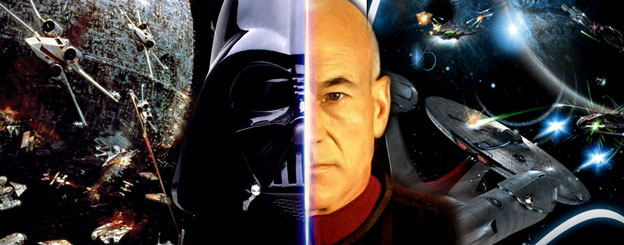
Which Side Are You On? “Star Wars” vs. “Star Trek”

WarsVersusTrek

There are many great conundrums in life. “Less Filling” versus “Tastes Great”; Ginger versus Mary Ann; and, since we just completed Thanksgiving, white meat versus dark meat. But there is potentially no greater debate than that of two of the greatest followings of the late 20th/early 21st century:  are you Star Wars or Star Trek?

Ever since the time of Jules Verne – hell, if we are serious, we’ve wondered since we drew images on the caves 35,000 years ago – man has tried to figure out what was beyond our earthly bounds. Leonardo da Vinci is alleged to have created blueprints for rockets and their flight; H. G. Wells used his imagination towards the subject to pen some of the great science fiction of the early 20th century and Albert Einstein actually did the math that would lead to our voyages to the stars. It wasn’t until other German scientists, led by Werner von Braun, actually harnessed the power of rocketry that those dreams became reality.

Since that time, mankind has achieved tremendous feats in the weightlessness beyond our Earth. There were the Apollo landings by NASA in the 1960s/70s, but the then-U. S. S. R. achieved longevity records for time in space and actually built the first long-term space station, Mir, in the 1980s (Skylab, for all of its exploits in the 1970s, only had three missions total with the longest lasting 84 days). Today, the International Space Station stands as perhaps the closest thing to mankind, regardless of nationality, joining together in our best efforts in space and its exploration.

The reach beyond the moon, however, has been limited to unmanned probes and satellites chocked full of cameras and data recorders that can capture the base information of the bodies it passes. These devices, however, lack the human capability of viewing the universe surrounding us and its wonder, of transmitting this astonishment back to a ravenous audience who wants to know what is out in the heavens beyond. Thus, we have to depend on the visionaries who have crafted a universe that soothes our curiosity somewhat but lights the fire of that same curiosity on another hand.

StarTrek

The visionary Gene Roddenberry was the first to take a crack at this difficult task. Star Trek, created by Roddenberry in 1966, showed a Planet Earth that didn’t recognize national boundaries anymore but organized under the “United Federation of Planets.” The flagship of the Federation was the starship Enterprise, captained by James Kirk (and later Jean-Luc Picard) and replete with all nationalities from Planet Earth on board.  There was even an alien, Mr. Spock, who hailed from the planet Vulcan. Their “five year mission” was to explore the galaxies and discover new situations, something that has been a human trait since crawling out of the primordial ooze.

The show wasn’t initially popular as people had a difficult time wrapping their minds around Roddenberry’s concept. Roddenberry was trying to detail the difficulties of society at that time in an arena where such discussion could be possible. While it may seem that Kirk’s machismo and swashbuckling style was the rule, examinations of race relations, destruction of the environment and the devastating effects of war were the overarching storylines that appeared. These themes (as well as many others) were the true staple of Roddenberry’s work on the program and over the wealth of Star Trek-related spinoffs over the past 50 years.
StarWars

In 1977, another entry came into the view of what the galaxy looked like. Envisioned by George Lucas and nearly as dear to him as Star Trek had been to Roddenberry, the movie Star Wars premiered on May 25, 1977. Initially not thought to be much by the studios (Star Wars was a toss-in with American Graffiti by Universal Studios to sign Lucas to a contract), the film would turn out to be one of the biggest movies of 1977, earning over $775 million ($1.3 billion today) worldwide in box office receipts (all totaled, the Star Wars franchise has earned over $4.4 billion in its existence). The film would go on to have five sequels/prequels, with the sixth – Star Wars:  The Force Awakens – set for release on December 18.

Since Star Wars joined into the “vision of space race” with Star Trek, however, there has been a battle between the franchises for the minds of fans. Many involved in this battle believe that a person may accept one of the franchises but cannot accept the other, forcing many to choose sides in this epic battle. My question would be…why? The two shows come at the subject of the universe from two completely different angles and, through combination, offer an excellent approach.

When he first conceived Star Trek, Roddenberry envisioned the “perfect” state of humanity – perhaps most importantly peace among the Planet Earth’s nations – that continued to thirst for adventure, knowledge and exploration of the interplanetary universe that surrounded their ship. They would achieve those goals in a state-of-the-art vessel that included the scientific devices that might be found in any assortment of satellites along with the eyes that could relate the wonder of what was being seen.

Star Trek came at the questions regarding the universe from a purely scientific standpoint. There was the philosophical contemplation about man’s (or any species’) place in the galaxies, the dilemma over how to handle a race or species that wasn’t as scientifically advanced and many other conundrums that we face even today. The devices used during the run of the Star Trek franchise have also become scientific items that are commonly used such as cellphones, medical scanners and the like. The Star Trek universe is continuing to expand despite turning 50 next year… a new television/web series is set to premiere on CBS in 2017.

Instead of an array of devices (although some of them were quite impressive…who doesn’t want a lightsaber?), Star Wars chose to tell the story of space as an opera, a Shakespearean play, rather than as a scientific endeavor. The clash of good versus evil, father versus son and even the collision of worlds and their destruction formed the basis for what essentially was a soap opera for geeks (and we can say that proudly, by the way). Each new incarnation of the film extended the story and it isn’t over yet; over the next few years, there are two more Star Wars-specific films in the works and several movie projects on characters – providing “background” to the stories being told – that make up the Star Wars universe.

Being able to accept both Star Trek and Star Wars as a future existence would be perhaps the way it was meant to be. While we have the technological amazement and advancements that would make such a journey a true adventure, there is also the potential for the dramatic and even perhaps violent turns that such journeys can take. In a perfect world, an interdependency between the two franchises and their theories would also prove to be the best approach to the potential problems of intergalactic travel, with each side providing the answer to the questions that are presented.

Thus, as both franchises continue on their individual courses, perhaps they are more alike than they realize. Perhaps they look to achieve the best that the human being – and aliens – can achieve in the myriad of parts that make us whole. Perhaps, just perhaps, Star Wars and Star Trek are the epitome of what we can be rather than the “one side or another” proposition that is offered.

“The Man in the High Castle” Is Captivating Television

It has been some time since we took a look at some of the new offerings from the movie, television or music worlds and that is a good thing. First of all, I’m not going to waste your time telling you about something that is completely awful (I know I said Quantico wasn’t very good, but it hasn’t been canceled yet…that means some people must like it). If I am going to take the time to offer up something, 9 out of 10 times it is going to be worth checking out (or at least I think so). That is what we have when we look at a new offering that has just been released.

HighCastle

There is a completely new world out there when it comes to the streaming services. The days of when these outlets simply provided a way to catch the latest movies or watch an old show (or a new one) are causing rapid changes in what they offer. Part of their attractiveness is that they can be watched over virtually any device. In the beginning it was just computers, then the outlets branched into tablets, cellphones and video game devices. Now, the HDTVs that come out (with the spanking new 4K technology and “smart” TV capabilities) have one or more of these streaming outlets pre-programmed on them.

Maybe it is because of the above that the streaming outlets made the moves they did. Such outlets as Netflix, Amazon Prime Video and Hulu Plus have decided to swan-dive into the deep end of the pool and produce their own shows rather than just offer the other networks’ material (and, in most cases, pay out the ass for the programming). Since I wasn’t around for the start of House of Cards or even Orange is the New Black, I am trying to find something that I can get into that is new to many (and can take over while I wait for the spring session of Blindspot and the second season of Mr. Robot to start) and it appears that Amazon has the next big thing.

Released on November 20, The Man in the High Castle is a ten-episode series that was foisted on the public all at once, meaning you can take it in the traditional episodic doses or can fully immerse yourself in it through a “binge.” This method of “broadcasting” (hey, it’s the only term I can think of that applies) has its pros and cons; it does allow you to blast through it in one big marathon but, if you take it one or two episodes at a time, you might forget that you are watching it and not go back to the series (confession:  I DVRed The Player, meaning to watch it but never did. It was canceled two episodes into its run). With High Castle, I sincerely doubt that someone is going to forget they have it in the library.

The series is based on the book of the same name written by one of the great minds of U. S. literature, Philip K. Dick. Dick, who wrote the science fiction classic Do Androids Dream of Electric Sheep? that eventually became the basis for the classic 1982 film Blade Runner (one of my personal favorites), this time steps into the alternative history genre and has the same impact there that he had with science fiction. The person who brought High Castle to the air, Frank Spotnitz (best known for his work on The X-Files), also deserves kudos for producing an excellent product.

The year is 1962, ten years removed from “V-A Day,” or the day that Nazi Germany and the forces of Imperial Japan defeated the United States in World War II. As a part of the peace, the Nazis take over the Eastern part of the United States virtually all the way to the Rocky Mountains, renaming it the Greater Nazi Reich; the Japanese, for their efforts, take over from the West Coast to the Rockies with their Japanese Pacific States. Between the two, running the ridges of the Rockies, is a Neutral Zone to separate the Nazis and the Japanese that has become an area to provide living space for segments of society (minorities, homosexuals and other “deviants”) that would otherwise be persecuted or even killed for who or what they are.

It is a tenuous peace between the two international powers, however. An aging Adolf Hitler is in failing health and, as Himmler and Goebbels jockey for position to take over from him, the Japanese grow concerned that Hitler’s death would result in warfare that would force them out of the former United States. Since the end of WWII, Germany has become a technological powerhouse, developing the hydrogen bomb and planes that fly from New York to San Francisco in two hours, while Japan has languished in its imperial peace. This is an important part of the program, but it isn’t the only plotline to pay attention to as the show continues.

The show opens up with a young man, Joe Blake (Luke Kleintank), visiting a factory in New York City on the seemingly innocent premise of looking for a job. He strolls through a totalitarian Times Square replete with the Nazi swastika burnished on video boards and flags and, upon reaching the factory, finds the manager. As we sit in on their meeting, we discover it isn’t for a job in the factory; Joe is being hired to drive a truck across the Greater Nazi Reich to Canon City, a town in the Neutral Zone, for The Resistance, a rebel alliance looking to oust the Nazis from the country.

After demonstrating his will to do the job, Joe gets the keys from the manager just as Nazi troops raid the factory. While the bullets fly, Joe is able to get away from the factory intact, but everyone else is not so lucky. The Nazis summarily execute everyone who was in the factory save for the manager, who is taken into custody and, as we find out through the first episode, tortured mercilessly.

As Joe is doing this, we go to San Francisco where another part of the story is developing. Juliana Crain (Alexa Davalos), who has assimilated nicely into a post-war Japanese society (taking aikido lessons and embracing their medicinal and cultural offerings), is stunned to meet up with her half-sister who tells her she has a great new job. Later in the evening, Juliana and her sister meet again under much more dire circumstances; Juliana’s sister hands her a package and cryptically tells her to take care of it before running away. As Juliana hides in the shadows, Japanese soldiers execute her sister in the street.

Running home, a perplexed Juliana (why would soldiers kill her sister) looks in the bag her sister gave to her. In the bag is a film entitled The Grasshopper Lies Heavy and, after viewing the reel, Juliana discovers it is an alternate reality film based on what happened if the Allies had instead won World War II (you with me so far?). Spurred to action by watching the film and the death of her sister, Juliana leaves her boyfriend (Rupert Evans) who hides that he is part Jewish, a crime punishable by death even in the Japanese Pacific States, and heads for Canon City with a ticket procured for her sister to make the trip.

The remainder of the first episode brings our protagonists to Canon City. Blake has what might be called an uneventful run but discovers that, out on the Great Plains, hospitals are crematoriums for the sickly and elderly instead of healing (remember, that’s Nazi Country). Juliana has her own issues, with a female passenger on the bus she is taking to Canon City mysteriously stealing her belongings but not the movie reels. The first episode ends with a twist that I honestly didn’t see coming and, after seeing it, nearly made me rocket into the second episode rather than allowing the first one to sink in fully.

Beyond the point that we have several different plotlines intersecting in this one hour – the impending death of Hitler and the potential for war between the Nazi and Japanese, the trips of both Blake and Crain to Canon City to do what isn’t exactly known and the film (is it possible it’s true?) and its purpose – there is an attention to detail in creating the false reality of “this” divided U. S. nation that is remarkable. There are far too many things to point out that helped to convey the dread and dismay of the conditions of living in such a situation and, with the supporting cast, all viewpoints are offered (Crain’s mother hates the Japanese for killing her husband; Blake meets a police officer who was in the U. S. military but now accepts his fate with the Nazis). It potentially indicates that there are some deeper analogies that we might see in the future of the program.

The Man in the High Castle also showed me that there is a new reality to the future of television. Unrestrained by broadcast guidelines or traditional “broadcasting times,” these shows being put out by the streaming networks are quality works that should demand a great deal more attention from the viewing public. If every program was of the high quality that High Castle is, then there would be a greater impetus to “cut the cord” from normal cable and network broadcasting, which have become staid with their product.

If you haven’t had a chance to check out these streaming channels, you’re missing out on what could be a bountiful arena of choices for your viewing pleasure. You’re definitely missing out on one of the best programs of the year with The Man in the High Castle; I’d suggest climbing onboard the wagon soon for both the show and for the streaming channels.

How to Fix the Presidential Debates

2016GOPCandidates

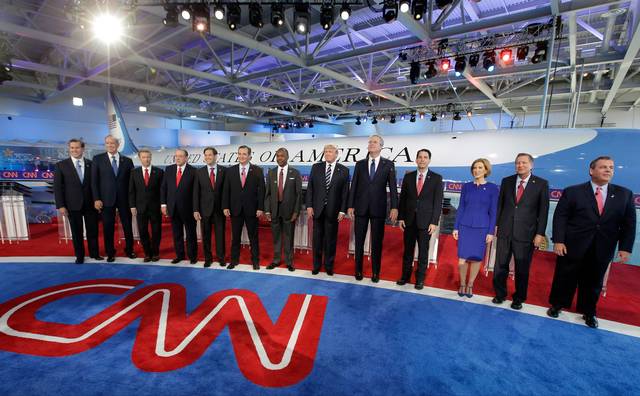
Since the conclusion of the last GOP Presidential debate that was held on the cable network CNBC – a truly dismal effort that left nobody satisfied with the outcome – there has been bellowing from pretty much everyone. Yes, the CNBC debate was a clusterfuck from the start – with three moderators and two guest questioners, it was never clear who was in charge – but once they became coalesced around an issue, the Republican debate participants struck back with veiled threats against the “mainstream media” (important point here:  if you’re going to govern a country as vast as the United States, you’re going to need that “mainstream media” at some point to get things done). It left the entire night as a giant stain on the 2016 Presidential campaign process.

The candidates complained about a multitude of things, including the length of the debate, the number of questions received, the quality of the questions and so forth. The moderators, in their defense, were faced with participants who, when presented with a viable question – such as Dr. Ben Carson’s involvement with the snake oil provider Mannatech, Senator Marco Rubio’s attendance in the Senate, how billionaire Donald Trump plans on paying for his myriad of xenophobic programs or why Senator Ted Cruz was against the recent compromise that passed a federal budget out of Congress and to President Barack Obama for the next two years – either didn’t answer the question, answered another question that they wanted to answer, waited for a partisan GOP audience to air their opinion through booing or attacked the moderators and the media. When you have this type of Mexican standoff (which Trump is now looking to wall off at Ciudad Juarez), there’s not much that is going to occur in said debate.

Now the candidates have decided to set up their own rules for how debates will be conducted. There is supposedly a letter that a majority of the 14 remaining candidates in the GOP race have gotten behind (bypassing the logical arranger for such events, their own Republican National Committee) that is being sent out, but it isn’t to be taken seriously. The letter supposedly would allow the candidates to vet the moderators, review the questions of the debate before it is conducted and such bullshit as whether there will be a gong, bell or buzzer to indicate their time is up when answering a question.

It was announced on Thursday night that next week’s debate on November 10 (which wasn’t expected to fall under this supposed “letter” being drafted) and being aired on Fox Business Channel will already have a smaller “main event” field. Through their criteria, Fox Business has chopped the “main event” debate stage down to eight, separating New Jersey Governor Chris Christie and former Arkansas Governor Mike Huckabee off to the “kiddie table” debate beforehand. That “kiddie table” debate has also been chopped, with former New York Governor George Pataki and current South Carolina Senator Lindsey Graham being eliminated from the debates altogether. Those that are being dropped down or out completely are not polling at the prescribed levels by Fox Business and, as such, have met the axe as to the debates and probably will soon as a viable candidate in the GOP race.

As a result of some of these changes, get ready for more whining out of the GOP candidates. If the GOP candidates – and also their Democratic brethren – want a chance to take on a serious debate, replete with issues to discuss, then it would be necessary to follow these rules.

2016DemocraticDebates

Both Parties Must Have a Debate On Foreign Ground – The GOP is the only party who has stepped outside of their traditional “home turf” of Fox News (or Fox Business), where they could be semi-comfortable in that they would receive a decent hearing (even these GOP candidates, however, complained about the Fox News debate). The CNN GOP debate was considered to be quite good as the longest debate yet, providing for more discussion of the issues but not enjoyed by Trump or Carson, who lack the background to describe how their policies would work other than “they’ll be great.” By this point, you already know about the CNBC snafu. The Democratic Party hasn’t left its cozy home with CNN and their next “debate” – a candidates’ forum in South Carolina on Friday night that will feature former Secretary of State Hillary Clinton, current Vermont Senator Bernie Sanders and former Maryland Governor Martin O’Malley (Lincoln Chafee, Jim Webb and Lawrence Lessig have ended their campaigns since the first Democratic debate a couple of weeks ago) – will be hosted and aired by MSNBC and commentator Rachel Maddow.

Each party has their partisans; I would be more interested in how they speak to a hostile audience and, just maybe, both sides could have a chance at swinging those in the middle ground to some of their viewpoints (this would also help as far as governance, but that’s another story for another time).

The Arbiter Determines All – While one or two moderators is OK, one should be the rule. There should be only three questioners involved in the game and the participants in the debate have NO RIGHT to choose who they want to fire questions (why would I want to hear you and a “friendly” questioner lob softballs all night?). Finally, there will be one voice who makes all determinations on the floor of the debate hall – The Arbiter (usually a moderator would do this, but they are too encumbered by their own networks to draw in ratings and worried about any potential future dealings with the candidates to have the balls to do anything).

The Arbiter will be an unknown person, presumably with knowledge about debate procedure, the subjects that would be presented during the debate, the histories of the participants involved in the debate and should have as little involvement with one political side or the other or be in media as a current broadcaster (if it has to be, then The Arbiter should be from the opposing party or media outlet – couldn’t you imagine someone from the Wall Street Journal serving as The Arbiter for an MSNBC debate and someone from the New York Times handling the Fox debates?). The Arbiter will be in charge of officiating the event and providing the punishments (we’ll get to that in just a second) that will be meted out for violations of the debate protocol. At the end of the debate, The Arbiter slinks back into the dark, never known by those who were in attendance.

The Arbiter will have several weapons at his/her disposal:

Question Refusal – The Arbiter will have the right, after a question is posed, to determine if the question is worthy of being answered. Such questions as whether some other candidate has the “moral authority” to do something or something that prods two candidates to spat at each other over insignificant bullshit would be the main thing that The Arbiter is looking for. If a questioner poses such a question, the first infraction is a warning with a second infraction resulting in a 10-minute penalty (removal from the debate). A third violation will result in the questioner’s removal from the remainder of the debate.

Microphone Control – The Arbiter would have control over the candidates’ microphones for the purpose of keeping them on track with questions. If a candidate is posed a question and said candidate either starts off on a tangent or doesn’t address the question directly, The Arbiter has the power to cut the candidate’s microphone. The Arbiter will pause for five seconds before reactivating the candidate’s microphone and, if at any time during the candidate’s response he goes off topic again, The Arbiter will end the question by shutting off the microphone for the remainder of the question.

The Arbiter will also be in control of how long the candidate speaks; once the candidate has reached the maximum allotted time (60 seconds in the previous debates), The Arbiter will cut off the candidate’s microphone permanently unless asked a follow-up question.

If the candidate cannot keep on track with his replies to the questions being posed, The Arbiter will have the right to remove the candidate from the debate or, if the candidate refuses to move, will have his microphone cut off for the remainder of the debate and his/her constant interruptions will begin to annoy everyone.

Question Count – The Arbiter will be responsible for keeping a running count (can be aided on this by electronic timing of each candidate’s responses) or time bank on how many questions each candidate has received and/or how much time each candidate has been speaking. If The Arbiter notes a predominance of questions to a few candidates, then he will inform the moderator and the moderator must change tactics and ask other candidates questions until The Arbiter feels it is balanced out.

Have a Manageable Debate Field – This has been the major problem with the GOP debates is the number of people on the stage. When you have 10 candidates looking to make their mark in a two hour debate, the most a person is going to be able to speak is probably around seven or eight minutes (once you deduct commercials, opening and closing statements and audience applause/outrage/outbursts). In the GOP field, there is probably no more than six viable candidates (I’ll let you choose your six); the Democrats have already limited their field from six to three, so they are on course for the primaries.

The whittling of the field is useful because, if you’re drawing 1% of the vote six months to a year after you announced your candidacy, the likelihood of you earning the party’s nomination next summer is highly unlikely. It’s simply a numbers game in that you aren’t going to get the attention as someone at the back of the pack that the frontrunners are going to get from being the, well, leaders. It IS a Catch-22, but that’s the way many things are in life. Unless the front six are mysteriously overcome with a debilitating illness that renders them incapable of running for office (and Christie isn’t above trying to inflict said illness on the frontrunners), you’re going back to your previous job or hosting duties on Fox News.

Implementing these rules – and simply letting the respective committees, the RNC and the Democratic National Committee – handle the nuts and bolts of debate preparations is the logical way to go. You’re running for the most important office in the United States; being concerned that the debate hall has a temperature more than 67 degrees shouldn’t be on your mind. Policy thoughts, debate tactics and proving yourself to U. S. citizens should be your goal. As President Obama also stated earlier this week, if you aren’t able to handle the queries of journalists from the news networks, you’re going to have trouble handling Putin.

Will these rules be adopted? No way in hell…but it would make for a more streamlined debate with plenty of policy discussion. And who wouldn’t want to see The Arbiter enforce his rules on both bags of bozo biscuits running for President?

The Coming Downfall of Broadcast Television

Roku4

There have been some things that have been consistent in the average person’s life when it comes to entertainment. The theater has been around since the Greeks and Romans put plays on in their massive outdoor amphitheaters and musical concerts have almost the same longevity. The change has come in the way that those things – acting and musical performances, along with sporting events – have been delivered to the populace.

In the really “old days,” the only way to partake of these artistic or athletic endeavors was in a live setting. With the creation of radio, it became possible for people to join in on a concert or sporting event from several hundred, even thousands, of miles away. When television came along in the 1920s, the picture was added to the radio broadcast and became the preferred way for people to witness events from thousands, even millions (remember the moon landing in 1969?), of miles away. As technology improves, however, many of these avenues are becoming extinct or may become extinct over the next decade or so.

First to go was radio. The normal terrestrial radio – replete with commercials – lasted for over 100 years before the advent of satellite radio came along. At first, many said “I’m not going to pay for radio,” but, as time, technological improvements and personal choices came to the fore, people decided to pay for satellite radio. Today, SiriusXM and its array of channels challenge terrestrial radio across the board in the ability to deliver breaking news, sporting events and musical events and artists’ recent musical output. It doesn’t bode well for the future as more terrestrial radio stations become “automated” – basically eschewing live DJs for stale canned programming to reduce costs – and the satellite stations boom, basically destroying an industry 100 years or more in the making.

A similar situation is happening in the world of television. Just a little younger than the radio industry, television has been a staple of U. S. households since it was popularly mass-produced in the 1950s. Over the past 60-plus years, television has not only brought to those around the world important historical moments – the moon landing, the fall of the Berlin Wall, the standoff at Tiananmen Square, the bombing of Baghdad in the first Gulf War – but has also brought hours of entertainment through movies, musical concerts, comedies and dramas.

Those traditions are quickly changing and nothing shows it more than the recent announcements from two powers in the television world, one a major network and one a cable powerhouse. It was announced on Monday that CBS Television Studios would be bringing a new entry into the Star Trek universe come January 2017. While not commenting on what tack the new series will take, it does have the power of Alex Kurtzman, who produced the 2009 theatrical version of Star Trek and 2013’s Star Trek Into Darkness, behind it.

The crossover of Kurtzman from the Big Screen to the Little Screen isn’t the important change, however. CBS has already stated that the premiere episode of the new Star Trek series would be broadcast on its regular network airwaves. Following that, the premiere and each new episode would be seen on CBS’ brand new on demand outlet, CBS All Access, and would not be broadcast on the traditional airwaves ever again.

After this announcement regarding the CBS/Star Trek partnership, it was announced on Tuesday that longtime cable television giant HBO and former The Daily Show front man Jon Stewart had joined forces for him to issue commentary during the upcoming 2016 Presidential campaigns. So what will be the name of Stewart’s new show that will premiere next year? It won’t be a show and it won’t be on HBO, fans; it will be “short form digital content,” or online efforts, with Stewart offering commentary that will appear over HBO’s on demand and streaming outlets HBO NOW, HBO GO and other arenas.

What do both of these legendary entries do? Sidestep the traditional broadcasting arenas in favor of online or “streaming” outlets, signifying that there is a coming downfall of broadcast television.

NetflixLogo

Since the beginning of the 21st century, this transition has been pretty easy to see coming. Netflix wormed its way in with its creation in 1999, initially offering only DVDs to customers as an alternative to the “big box” movie rental outlets such as Hollywood Video or Blockbuster Video. Not only did Netflix crush those outlets with its business plan, they soon grasped onto the idea that they could do television just as well as the traditional broadcast networks. Such now-acclaimed dramas and comedies as House of Cards and the resurrected Arrested Development got their start in 2013 on Netflix and the acclaimed Orange is the New Black premiered in 2014. Since these and other shows premiered, Netflix has earned over 50 Emmy nominations and won 11 times.

After Netflix showed the way, there were many who followed. Hulu and Amazon Prime Video now have their own streaming video networks in addition to their usual movie rentals and they have made their impacts not only on broadcasting but on awards shows with their own original programming. Even the traditional networks, such as what CBS has done above, have entered into the digital arena.

ChromeCast

If you’re going to have the non-traditional broadcast sources, you have to have a way to get it to the people. With Roku, ChromeCast, AppleTV and software on the Xbox and PS4 video game systems, there are ways to use an internet connection to pretty much see anything that might appear on network television that same day or within a couple of days of a program’s original broadcast (if it is on the network’s digital outlet, then the next day). The combination of these internet streaming options plus the drive to sever the ties with cable could very well doom the traditional network outlets and cable television.

Cable television, as traditionally offered by Comcast, Time Warner and several other outlets, offers different packages for homes in their areas. Households can pay anywhere between $20 (for the barest bones package that basically only gives the local broadcast networks) and $300 (for every bell and whistle available, not to mention internet access and/or phone) for cable television programming. If people were able to make the choice to buy the channels that they like and want – say a Netflix here, an ESPN there, etc. – and pay drastically less than what they pay for cable, people will do that in a heartbeat.

Cable broadcasting will more than likely end when those device providers – Roku, ChromeCast and the others – start providing “bundles” of channels at a low price for their viewers (this might also be the saving grace of broadcast television in that they could negotiate rights, much like they already do with the cable companies, with the streaming providers). These “bundles” could offer local television station programming, a sports channel or two, a movie channel and a news channel for next to nothing. You could have a sports package, a movie package or a news package to go alongside the local channels that can be picked up with a digital antenna. Then there is always the fallbacks of Netflix, Hulu and Amazon that could bring the programming.

There is one problem that could be present for those looking for the utter devastation of cable. Live televised sports still provide the most viewers in television – look at the numbers for football’s Super Bowl or for soccer’s (the rest of the world’s football) World Cup. The individual leagues have been looking to this, however, and have come up with streaming options that could easily make their way to a streaming home.

Major League Baseball’s MLB.tv is something that is offered year round (usually using the feeds from the local team’s affiliate) and the National Football League recently broadcast one of their games between the Buffalo Bills and the Jacksonville Jaguars not only from London, the United Kingdom but also exclusively streamed over the internet. If the individual leagues can figure out a way to remove the broadcast networks from the equation and monetize their offerings, they will be the first to “cut the cord.”

And this doesn’t even add into the mix the expanding world of mobile programming, or watching traditional television on your cellphone…

The moves by CBS and HBO (and others, to be honest – the situation is rapidly changing) to bypass the traditional network broadcasting routine for straight-to-digital broadcasts signifies a seismic change, a strange new world for the future of television broadcasting. Will the other companies in the industry catch up? Will the cable companies be able to make adjustments in their offerings? Will the streaming channels and the devices that provide them take the idea of “cutting the cable” all the way to the logical fruition of cable’s destruction? The coming years will provide the answers.

“Blindspot” A Grey Story That Keeps You Guessing; “Quantico” Misses the Mark

If the calendar has passed the Autumnal Equinox, it must be time for the newest television shows to hit the airwaves of the traditional television networks. Usually these new programs are retreads of past tropes (cop shows! buddy comedies! fish out of water situations!) or are as intriguing as watching a hangnail, which is pretty much the reason that many viewers have left the traditional networks for the various cable, pay networks (HBO, Showtime, etc.) or the growing streaming services (Netflix, Hulu, etc.). Still, there are a few shows that will break out for the networks and make it worthwhile to watch commercials.

It is estimated that the major television networks call for somewhere between 20-60 “pilots” to be filmed that will give them a crop to go over and decided which are worthy of airing (or, on the other hand, give them fodder for what used to be the “slower” summer schedule). Cable networks may be counted in this as, once a network has decided to pass on a particular project, it may be revived by such networks as TBS, TNT, FX and others for their channel. This doesn’t stop the cable networks – nor the pay networks or the streaming services – from doing their own thing, however, so it’s conceivable that there could be somewhere around 100-150 pilots out there, of which potentially just 20-40 make the cut.

In 2013, there were a grand total of 26 new series’ (comedic, dramas and reality) that premiered on the major television networks. Of that number, only seven (including the outstanding The Blacklist and the iffy Brooklyn Nine-Nine) survived to come back the next season. In 2014, the number of premieres stayed almost the same (25) as did the survival rate (8). For 2015, the number has dropped to 17 and, by the end of the year (hell, maybe by the end of October), we’ll probably have a good idea as to how many of those will come back for a second season next fall.

One of those that should have a long shelf life (or the potential is there for it to have one) is the new NBC series Blindspot (Mondays at 10PM Eastern Time). From the start, the show lays down its premise very well – after Times Square is cleared out due to a duffel bag left in the street, an amnesiac woman emerges from said bag completely covered in intricate tattoos on her naked body – in that this Jane Doe (Jaimie Alexander) is the key to something. That’s where the story gets a bit grey, though, and it serves to pull the viewer into the program while giving out drips of information along the way.

FBI Special Agent Kurt Weller (Sullivan Stapleton), the lead investigator following Jane Doe’s – rescue? capture? recovery? you’re really not sure – apparently has a tie to whoever tattooed Doe as one of the decorations on her back addresses her to him by tattooing his name on her directly. Weller discovers after questioning Doe that she doesn’t have any recollections of who she is, who was the artist behind her tattoos or why she was in the bag in Times Square. As Weller – and the audience – finds out deeper into the program, these aren’t the only mysteries that Jane Doe brings to the table.

In the premiere episode, one of Jane Doe’s tattoos – a few lines of a Chinese dialect hidden behind an ear – are translated by Doe (amazing the FBI agents around her, including Weller) as an address in New York City. Heading to the address with Doe in tow (who is understandably quite interested in figuring out what the hell is going on), the FBI finds that a Chinese national is plotting to blow up the Statue of Liberty. At the same time, we learn a bit more about Doe as, while she is attempting to stop a man from beating his wife in the apartment complex, she shows off hand-to-hand combat moves that would make Jason Bourne proud in taking down two attackers.

The investigation – into both the Chinese national’s plot and Doe herself – continues, where we learn that Doe COULD be a “black ops” agent trained by the Navy Seals. Meanwhile, the FBI team rushes to the Statue of Liberty, where Weller and Doe take the terrorist down as Doe unlocks a part of her memory – her undergoing weapons training with an unknown bearded gentleman – and prevent the attack from taking place.

While we won’t get into the gist of the second episode (a fascinating story about a former military pilot who hacks a drone to carry out attacks on U. S. soil against those who wronged him), you’ll get enough from the first two episodes to see that this is a show that will have some staying power. Overall it is a “grey” story in that the characters all have some faults that they have to work through, the heroes aren’t all wearing white hats and the bad guys aren’t all twirling their mustaches. For Weller, it is the disappearance of a childhood friend that drove him to join the FBI; for other agents on the team, it is in how much they can trust Doe; for Doe herself, it is who she actually is and if she’s actually a force for good or a tool put in place to cause eventual catastrophe.

The only thing that might derail Blindspot is if it becomes an episodic “Terrorist of the Week” show. Sure, we need to know what happened to Jane Doe, but the team doesn’t need to stop a terrorist from destroying the Five Boroughs every week or stop some sort of crime. Through the usage of the tattoos covering Doe (that seems to be the directional after they are translated by the supercomputer built by the scientist working with the team), we’d like to see them give us more information about the characters and have them grow along with our knowledge of Doe. As long as Blindspot can keep me guessing, I am going to be hooked on the show.

The same cannot be said for the new ABC show Quantico (Sundays at 10PM Eastern Time). The open of the program introduces us to first generation Indian-American newbie FBI agent Alex Parrish (superb Indian actress Priyanka Chopra), who is lying amidst the rubble of a massive terrorist attack in New York City (apparently it has become OK again to depict the Big Apple as the target of terrorists, but that’s an argument for another time). After being plucked from the wreckage by fellow agents and New York’s finest, they put her to the task of identifying from her FBI training class the person who is responsible for the attack.

Here is the first problem with Quantico. From the Incident Command Post in New York, we are whisked back to when Parrish heads off to training with the FBI at its namesake headquarters. Along the way, we are quickly introduced to other members of her class:  a gay man, a Muslim woman, a “legacy” whose parents were both FBI agents and, of course, a hunky guy that Parrish meets on the plane to Quantico and has sex with in his car upon hitting the ground in Virginia (Parrish doesn’t believe she’ll ever meet the guy again; she’s slightly surprised when he shows up in her training class).

The problem is the constant “time hopping” back and forth of the program. Just when you’re beginning to get a gist for what is going on in “real time” (the terrorist attack), you’re pulled out of the situation and plopped back to when the major players were at Quantico undergoing training. While there are moments that push along the plotline (SPOILER ALERT:  a suicide in the premiere episode, driven by an exercise in investigation, brings out plenty of information), the overall feeling of the “school days” of the FBI agent-wannabes is that’s where the writers and producers want to push the “sexy” side of the story, with more emphasis on individuals hooking up than their coursework. Instead of concentrating on one side or the other, you’re never really sure what is supposed to be the main story that is being told by the writers.

By the end of the first episode, it is pretty easy to deduce what is going to happen. Parrish, as she is shocked to learn, is believed to be responsible for the terrorist act and is taken away in cuffs and leg irons on the order of one of her FBI instructors Liam O’Connor (Josh Hopkins). While they are driving away from the scene of the crime, the driver whips out a stun gun and zaps the guard sitting beside the driver and busts Parrish out; the driver is Parrish’s Quantico class director Agent Miranda Shaw (Aunjanue Ellis), who informs Parrish she is being framed for the terrorist attack and has to find out who actually did it (it is still a member of her graduating class from Quantico) and who is setting her up to take the fall.

The major problem that I have with Quantico is that I normally don’t like when my television programming is 50/50. You’ve got to be able to pull me in with a solid story and a raison d’etre before you start pushing different storyline arcs at me. In the case of this program, the writers have admitted they wanted to do a soap opera-style Die Hard; for me, that’s a no-go. I’d rather have the action than the bed-hopping, backstabbing and other “intrigue” that shows up in the soap opera genre. Put this together with the “time hopping” and I have to admit that Quantico is either something I’ll watch in passing or won’t bother tuning into again.

It’s Time for the VMAs, But Who Really Cares?

On Sunday evening, something that used to be a “calendar” event in the music industry will take to the Microsoft Theater (formerly the Nokia Theater) stage in Los Angeles, CA. For the 32nd consecutive year, the MTV Video Music Awards will take place, honoring the best video work in the recording industry and the performers who have given us their best (?). In reality, however, the MTV “VMAs” and their “Moonman” award have become a gauche award because nobody really cares about them anymore.

When MTV hit the airwaves in 1981 (in fact, on August 1 the station celebrated its 34th anniversary), it was a brazen broadside against the staid, stoic music industry and the radio industry and stations that would “make or break” careers in a heartbeat. The first video aired on MTV, The Buggles’ “Video Killed the Radio Star,” seemed like a four-minute manifesto of what was the intent of the new channel. Record companies and their artists for years had put together promotional videos that, for the most part, were only seen by a handful of people at the record companies and in the radio industry. When MTV came along, that suddenly changed.

Bringing together these hundreds of videos (literally…pretty much anything on MTV in the early days was seen quite often due to the lack of material), MTV slowly built an audience and, at the same time, became the place where new artists made their breakthroughs. Such artists as Madonna, Cyndi Lauper, Men at Work, Bow Wow Wow, Duran Duran and the Human League were getting their attention not through traditional radio play but from the constant airing of their music videos on MTV. The biggest move by MTV in its early years may have been the exposure it gave to black artists. Eddy Grant, Musical Youth and a young man embarking on a solo career by the name of Michael Jackson (among others) benefitted greatly from the exposure that MTV provided.

It also had a way of destroying careers. The 1981 Grammy Awards were dominated by a Texas newcomer named Christopher Cross, who earned the top four awards (Record of the Year for his eponymous LP, Album of the Year, Song of the Year for “Sailing” and Best New Artist) and seemed poised for a long career in the music industry. Due to his pedestrian features and roly-poly physique, however, Cross wasn’t the typical “MTV artist” and he quickly disappeared from the scene following his sweep.

A couple of years into their existence, however, the honchos at MTV were faced with with the dilemma of continuing to grow the channel and coming up blank. In 1984, the powers that be at MTV came up with what they thought would be the cure (no, not the band). Producing their first ever MTV Video Music Awards, the channel looked to give the same gravitas to music videos that the Grammys bestow on music or the Oscars give to cinema. Over the years, the show has provided MTV with some of its most outlandish moments while also being its most watched event.

Who doesn’t remember Madonna’s rendition of “Like a Virgin” at the very first VMAs? Or Madonna’s girl-girl smooch with the randy Britney Spears in 2003? How about Kanye West barging in on Taylor Swift’s “Moonman” acceptance speech in 2009 (one of the few times I actually felt sorry for Swift)? The clothes, the music and sometimes even the videos made the MTV Video Music Awards a spectacle for the youth of the era. Over the past few years, though, the futility of the VMAs has been mentioned and whether it is the iconic “happening” that it was in its earlier incarnation.

Part of the reason for that is in the maturation of MTV itself. About 15 years ago, MTV decided that it wanted to be more of a lifestyle channel for the young and hip rather than concentrate on music alone. To achieve this goal, MTV began to put on its airwaves things that weren’t the “traditional” fare for the channel. A host of reality and game shows were the start, followed by fashion and “home” shows (anyone remember “Cribs”?).

The reality trend that took over in the 21st century allowed MTV to pretty much switch over to just the reality shows, including the vapid Jersey Shore and other scripted programming (none worth mentioning). Lost in the mix? Music videos, the thing that borne the channel (part of that was in the fact that the record companies, looking to tap another potential revenue stream, wanted to start charging MTV for showing the previously “promotional” videos). Hence, here you have a channel which was formerly the “groundbreaking” arena for exposing new artists through their music videos – in fact, naming their station AFTER MUSIC TELEVISION – not even showing them anymore.

Videos themselves also seem to have disappeared for the most part. Back in 1982, Duran Duran released Rio, their second album. Using the new MTV format, the group was sent by their record company, EMI, to Sri Lanka and Antigua to film an unheard of 11 videos for the record. Those videos not only served to be a major part of the programming for MTV in its early years, it also established Duran Duran as megastars in the music industry and provided the group with a career that still exists today.

Today, videos are seldom done and, if they are, it isn’t for promotional purposes. More often than not, they are done by popular artists that have no need to garner additional airplay for their efforts (think of why Swift, who has somehow crafted a career in music, continues to put out videos that no one has ever seen) or as a “vanity project.” There isn’t a purpose anymore for the music video because there isn’t an outlet for it to air on (sorry, YouTube doesn’t count).

Which brings us back to this year’s VMAs. Of the nominees that are on the list, I’ve seen exactly two of the videos – Mark Ronson’s collaboration with Bruno Mars on “Uptown Funk” (outstanding song, great video and it probably won’t win shit on Sunday) and Florence and the Machine’s “Ship to Wreck” (a band I can’t get enough of that also won’t sniff a “Moonman”). The rest could be cartoons for all I know because there isn’t an outlet to show them anymore. The untalented Swift is nominated for nine awards while Ed Sheeran has six, with a smattering between Nicki Minaj, Kendrick Lamar and Beyonce and the “Video Vanguard Award” (think Lifetime Achievement Award) being handed to West.  Without an outlet, however, why hand out awards for something that will basically become a popularity contest?

Imagine, if you will, Hollywood continuing to crank out movies and television shows but every theater on Earth not showing them and no television networks to put the shows on? (This one could become reality with the advent of Netflix, Amazon Instant Video and Hulu starting to film their own projects.) Would there still be a slew of awards shows for basically something that doesn’t exist anymore?

As a former DJ and music aficionado, I used to sit with bated breath each year for the VMAs (and the Grammys, for that matter), not only to know who won what but for the outstanding musical performances that it brought to its stage (never enough rock, always too much pop). Nowadays the videos are all things that I haven’t seen and the “musicians” (and that term is a stretch in many cases) and their music are so over-produced they cannot perform their music live. Thus, you have to wonder if anyone even cares about the MTV VMAs anymore.

Sure, there will be some prepubescent teenagers who will watch as Miley Cyrus, this year’s host, tries to show how “adult” she is through some pseudo-sexual act she’ll perform onstage; Swift will still constantly look like a deer in headlights as she facetiously mouths “Me? Me?” after winning her umpteenth award and there will probably be some spat – usually between warring rap parties – that blows up backstage into a story. It’s time for MTV’s Video Music Awards for 2015, but does anybody really care anymore?

Wondering What Happened To…For August 25

Roxette1990

On occasion, I have thoughts that pass through my head that, while fully formed, aren’t exactly long enough to air out on their own. With this in mind, this recurring segment will catch all of those things in a neat little basket and deposit them with you, the reader. Hopefully you’ll enjoy these as much as the other writings you’ll find here.

With that, let’s get started:

Wondering what happened to the band Roxette while pondering…

Did Jon Stewart Leave The Daily Show For This? – If you missed it over the weekend, former The Daily Show host Jon Stewart was seen on television again. You had to buy the program to see him, however, as he was the host for World Wrestling Entertainment’s SummerSlam pay-per-view on Sunday. But, after seeing him on this program, I have to hope he has better plans for his post-Daily Show activities in the future than this.

During the “title versus title” match between wrestlers Seth Rollins and John Cena (and we won’t even get into who held what title, the story, etc., because it doesn’t matter), Stewart entered the ring with a chair as the “combatants” were both momentarily stunned, debating who to crown with the chair and allow the other person to win. After a couple minutes, Stewart – despite having nailed Rollins in the balls in a previous WWE broadcasts (remember, this is professional wrestling, where a kick in the groin is a strategic move) – chose to use the chair on Cena and allow Rollins to win the match.

After 16 years in the anchor’s chair at The Daily Show, Stewart more than deserved his glorious sendoff from the show. But if this is what Jon Stewart is planning to do for the remainder of his career (doubtful, but go with me here), then he better hit the gym because 50 year old bodies don’t hold up well under the wrestling grind…just ask The Undertaker.

Furthermore…

Did ESPN Report on a Professional Wrestling Pay Per-View? – While sitting around after the late local news on Sunday night, I turned over to ESPN to see what happened in the world of sports for the day. After a bit, the anchors discussed the events of the WWE pay-per-view as if they were a REAL sporting event, complete with having a reporter on the scene (a former WWE employee, it must be noted) to give a post-fight analysis.

I know that sometimes it’s difficult to come up with news and it has to be especially difficult to come up with sports news during the “dog days” of summer. But if you’re reporting on the results of a scripted event, then you really don’t know your fan base that well.

Is Anyone Surprised About Josh Duggar? – The Ashley Madison hack – where up to 32 million names and batches of personal information were stolen by a hacking group and subsequently dispatched over the internet – had some surprises to it. First, who knew that government employees were so kinky? Secondly, is anyone surprised that Josh Duggar’s name was on the list?

Duggar, the son in the bizarre (now canceled) television reality program 19 Kids and Counting that featured the Duggar family (Josh’s parents and siblings) with their breed-like-rabbits philosophy and holier-than-thou attitude, held a nice job “upholding” those family values with the Family Resource Council. That was a nice job until it came out he was diddling his sisters in their sleep at the age of 15 and his parents decided that all the little Duggar needed was some time down on the farm and didn’t report the situation to authorities. He resigned that job with the FRC, but the best was yet to come.

Amid the clamor of the Ashley Madison data dump (for you who do not know, Ashley Madison was a website where people could go to arrange for extra-marital hookups, or affairs as they are commonly known) the name of Josh Duggar came up. So not only was he a child sexual predator, as an adult he wanted to have relations with someone other than his wife and, considering what type of website it was, we’ve got to assume a pretty frisky sex session. If you look up the word “hypocrite” in Webster’s Dictionary, there is now a picture of Josh Duggar.

When your name becomes associated with something less than appealing (just look up “duggaring” and you’ll see what I mean), perhaps it’s time for you to shut up on the subject you’re railing against. Just ask Rick Santorum about that fact.

Want A Term for “Anchor Baby?” – Over the past few days, GOP Presidential hopeful Jeb Bush has been making his comments on illegal immigration and using the term “anchor babies,” much to the delight of the media. When they challenge him on using such a term (let’s be honest, not in the best taste), he angrily spins around and challenges the reporter, “You have a better term I should use?”

Yes, Governor, there is…it’s called a child. Whether you agree with the way it is portrayed by the GOP or not (the evidence suggests that the number of births of this nature in 2008 was 340,000, or approximately .1% of the U. S. population, and steady each year to 2015 instead of the millions the Republican Party would suggest every year), what an illegal person in the United States has done is given birth to a child that didn’t ask for this situation to be thrust upon them. For all the care that the Republicans have with a child before it is born, you would think that they would have some concerns about it afterwards.

Now, to answer the question…what happened to Roxette?

In the late 1980s, one of pop music’s catchier bands was the Swedish group Roxette. The twosome who made up the group, Marie Fredriksson and Per Gessle, were hailed as the second coming of ABBA while they delivered such memorable pop bubblegum as “The Look,” “Joyride,” “Dangerous” and “It Must Have Been Love.” In the United States, the band was popular but was difficult to put into the nice little cubbyholes that radio likes for its artists.

After the release of 1991’s Joyride, things went downhill for the band. Caught by the tidal waves that were the grunge phenomenon and rap music, Fredriksson and Gessle took a break in the mid-1990s that turned out to be longer than they wanted. After recording two records in 1999 and 2001, Fredriksson was diagnosed with a brain tumor in 2002 that saw Roxette shut down operations again. They would remain inactive until 2009, when Fredriksson had recovered enough to take the stage once again beside Gessle.

Roxette celebrated the 25th Anniversary of “The Look” (perhaps the song they are best known for), with a remix of the song with Swedish producers Addeboy vs Cliff in 2014 and a new album expected from the group by the end of this year. Gessle, now 56, and Fredriksson, now 52, continue to perform live in Europe, but currently there are no plans for the duo to return to the United States to attempt to recapture the magic.

Roxette2015

Mr. Robot a Unique Trip; Florence and the Machine’s Latest Rocks

The most fun thing about entertainment – be it movies, television, music, books, video games or whatever – is that individual tastes are accentuated. Because of this enhancement, there is virtually anything out there that people can digest and, perhaps, things that particular people avoid like the plague. Two things recently have raised my metaphorical radar in that they are excellently done and intriguing, at least to me.

Lately, television has been a bit of a wasteland for me. The last show that I REALLY got into was Leverage (as you already know) and it has been a trial to find something else to garner my attention. There’s only so many athletic events, historical shows (think Henry Rollins’ 10 Things You Don’t Know About…) and movies (VERY few) that you can watch before you would like to see something weekly that you feel invested in. On my DVR right now is the USA Network’s Dig (just waiting until the right moment – as in the announcement of a second season – to burn those off), but it will have to wait until the conclusion of USA’s Mr. Robot.

Mr. Robot is the story of a computer security drone named Elliot who shuffles through his humdrum life by day working for an omnipotent company called E Corporation (or “Evil Corp” to Elliot and his fellow employees – on a side note, the logo for Evil Corp is quite reminiscent of the Enron logo) and, by night, becomes a hacker vigilante who tries to right the wrongs in society. In the very first episode, Elliot finds out a local restauranteur is a pedophile and, rather than bribing the man with the information for a financial profit, turns him into the authorities.

It’s not enough for Elliot, however. He has a massive addiction to morphine, grinding up pills to snort them directly into his system, and counters it by taking anti-addiction medication to maintain a sense of stability. Elliot also is extremely antisocial, even around his childhood friend (and maybe a feeling of more from him) Angela, a manager at the security company that both work for.

Through their company’s work in providing computer security for Evil Corp, Angela and Elliot detect a hack during a DDoS (Distributed Denial of Service) attack that requires Elliot to fly with the head of the company to access Evil Corp’s massive computer database and eradicate a file before said attack ravages the Evil Corp systems. Elliot finds the particular bug file and, strangely, the file is directly addressed to whomever finds it. The file requests Elliot to leave it in the system, which Elliot does (with a few changes that put him in control of said file) and, from there, Elliot is off on a ride that he (and the audience) have no control over.

Elliot learns that the hack came from a group called “fsociety” (a clean version of “Fuck Society”) and its leader, a mysterious and legendary hacker by the name of Mr. Robot. Mr. Robot has a vision of leveling the playing field for all of mankind against the corporations and governments that “shackle” them through eradicating all records of debt that people have accumulated in their lives. Elliot, by the end of the first program, isn’t sure which side he wants to be playing for.

Not to give away too much about the program (it is currently up to its seventh week on the USA Network), but it is as trippy as it is intriguing. Add in a Chinese hacker team known as the “Dark Army,” a Russian couple, with the husband being a high-ranking member of Evil Corp (and both with some sinister plot as well as slightly twisted minds) and a member of “the 1% of the 1%,” as Elliot learns, gangbanging drug dealers (remember, Elliot’s an addict) and various other twists and you might find your head spinning.

Part of the reason I like the program is those twists that you don’t see coming. It has a darkness to it that is realistic and, along with that point, the characters speak as a normal person would (you’re going to hear “shit,” “dickhead,” and other assorted vulgarities, including bleeps for where “fuck” has been uttered). But it is done naturally and in the flow of show so, to me at least, it is unnoticeable. There are some plot holes and reality checks during the proceedings, but the science behind the hacking and how complex computer and internet are – or how lacking they may be – is solid.

They couldn’t have cast anyone better than Rami Malek to play Elliot. He delivers on the character with some excellent acting in the role and his appearance – some of it HAS to be his own – give you the impression of someone who is dealing with an opiate addiction. I also really enjoy Christian Slater as Mr. Robot; he is able to play psychotic, caring, nurturing, demanding and rebellious, sometimes all within the same scene.

If you’ve got On Demand with your cable system, you might want to catch up with Mr. Robot as it is well worth the time spent (the first six episodes should be there). Once you’ve caught up, Mr. Robot airs on the USA Network on Wednesdays at 10PM Eastern Time.

On the musical front, I often despair. 2015 has been dominated by the post-teenage Disney chicks such as Ariana Grande, Demi Lovato and others that I just can’t get into fully. I can enjoy Jason Derulo and Bruno Mars, but other male vocalists just don’t capture my attention.  Nicki Minaj and Iggy Azalea aren’t exactly my taste and don’t even get me started on Taylor Swift. Never has someone done so much with so little talent, except maybe for a Kardashian. And she’s supposed to be what many consider a “fashion plate”; in my eyes, the clothes looked better on the hangar than on Swift (I’ve seen 2×4’s with more curves).

As such, I normally go to alternative music, although my penchants favor the hard rock/metal scene (and most of that, honestly, even bores me nowadays). Recently Florence Welch and her band, Florence and the Machine, released their third album called How Big, How Blue, How Beautiful. Many of you might not have heard of the band since their debut back in 2009, when the song “Dog Days Are Over” was a big hit on radio. But Florence and her gang aren’t easy to put into one of the nice little cubbyholes that music likes to use, hence the band’s difficulties over the past six years.

Their debut album Lungs was a treasure trove of different musical stylings that demonstrated the power of Florence and the Machine’s music and, in particular, Welch’s voice. Along with “Dog Days Are Over,” the song “Kiss with a Fist” and “Hurricane Drunk” were the outstanding tracks that showed the promise of the band. They were rewarded with being nominated in 2011 for Best New Artist at the Grammys, an award that went to Esperanza Spaulding (who?) over the group, the rapper Drake, the folk band Mumford and Sons and even Justin Bieber.

The follow-up to Lungs, 2011’s Ceremonials, was an even bigger hit for Florence and the Machine, allowing for the group to really take their time before stepping into the studios for their next effort (that and the closure of their record company, Universal Republic Records, helped to give that time). Going back to the studio last year following the breakup of Welch’s then-relationship, How Big, How Blue, How Beautiful was recorded and released in June 2015, with the band touring the major music festivals, including last weekend’s Lollapalooza show in Chicago.

The musical stylings of How Big, How Blue, How Beautiful, run the gamut. On the first single, “Ship to Wreck,” Florence and the Machine echo Morrissey, albeit with a few more guitars and a lot more power. “What Kind of Man” is a rocker that sounds as if the Tower of Power horn section was imported for backup, while “Caught” and “Delilah” capture the attention of the listener. Along the way, Welch’s powerful and emotional vocals rule the roost, evoking memories of a more-rock oriented Kate Bush or, for a more contemporary comparison, Adele. In fact, a sing-off between Welch and Adele would probably lead to a stalemate as both blow speakers out with their vocal talent.

All three of the albums are well worth owning, but How Big, How Blue, How Beautiful is the way to go for a complete look at the power and potential of Florence and the Machine. Be sure to get the extended version as it contains “Make up Your Mind” (another outstanding song) and the demo version of the title track, showing the development of the song from incarnation to finished product. You can’t miss out on what should prove to be the album that takes Florence and the Machine further into the consciousness of music audiences.

Equal Opportunity Outrage for Everyone!

The past week has seen the cup of outrage overflow onto the carpet of hysteria. Incidents that occurred in the United States and other areas of the world seemed to boil down to see who could “out-outrage” the others in some macabre competition. To run them all down – and this isn’t even looking back to previous weeks, when the “Outrage-O-Meter” was pegging itself – would take hours, but here’s a few of the choice tidbits from the Happy Ending Machine over the past seven days.

Last week, former Arkansas Governor Mike Huckabee, attempting to catch up to the bloviating gasbag that is Donald Trump, commented that the deal negotiated with Iran regarding its nuclear ambitions – and this isn’t negotiated with just the current U. S. administration but also the leadership of the United Kingdom, France, Japan, China and Russia – was President Barack Obama “leading Israelis to the doors of the oven.” Through trying to out-insult The Donald, Huckabee instead offended people on both sides of the Atlantic, not only the U. S. but also Europe and Israel – the very people he’s looking to “protect.”

Then there was the false indignation that the Republican Party had regarding the release of illegally recorded videotapes of a high-ranking member of Planned Parenthood talking untastefully and rather loosely about the usage of organs and tissues from fetuses by the organization. Rather than actually sanely speak to the head of Planned Parenthood about the issue, several members of the GOP rallied around the “defund Planned Parenthood” bandwagon, despite the fact that less than 2% of their operations are abortions and much of their work benefits women who otherwise wouldn’t have a gynecologist to examine them.

If that was an easy one to get people to fire up the pitchforks over, then the news from Africa just sent everyone on a bizarro rampage. An African lion by the name of Cecil – who everyone claimed was world famous but I had never heard of before this brutal happening – was lured by a big-game (but small-dicked) hunter/dentist from the U. S. (in particular the state of Minnesota) and his filthy “guides” (called such because who accepts money for hunting animals…isn’t that the job of the “hunter”?) out of his sanctuary in Zimbabwe. Once out of the sanctuary, Mr. Little Dick decided to pump a shot from a crossbow into Cecil which, as anyone who knows weapons will tell you, you better be a damn good shot to kill them on the spot. Alas, Little Dick wasn’t and the chase was on.

For the next 40 hours, the Three Assholes decided to track Cecil before killing him off with a gunshot. It was only THEN that the group discovered that Cecil had a GPS tracking device, which they allegedly attempted to destroy, then hacked the head off the lion in a last act of deviance while leaving the carcass. All in the “glory of the hunt.”

Finally comes this gem. A woman who was the daughter of one of the survivors of the Sandy Hook shootings wrote an open letter to comedian Amy Schumer on Medium.com that implored Schumer to take up a stance for extending gun control laws. What was the basis of this? The shooting in Lafayette, LA, last week that saw two women killed at a theater that was showing Schumer’s hit film Trainwreck.

The young woman writes in the letter, “Amy Schumer, I and many other Millennials look up to you so much. You are our generation’s epitome of what it means to be a strong, powerful, self-aware champion for the experiences and truths of being a woman and an American today…And we need your voice in this movement. We need your help…Write an op-ed. Support an organization. Demand change. Be a voice for our generation and for women – two groups who make up most of the victims of the gun violence in our country.”

And this doesn’t even get into the situation between Palestinians and Israelis on the West Bank in Israel, the NFL’s Roger Goodell upholding the suspension of New England Patriots quarterback Tom Brady or the latest in a long line of cop shootings, this one in Ohio, that are dominating the headlines.

Outrage, when used appropriately, can be a powerful catalyst for change in the world. In the early 1960s, the outrage people felt when seeing how peaceful marchers seeking equal rights were treated in the Deep South forced quick change after over 100 years of supposed “freedom.” Outrage can also take longer periods of time, such as with the Vietnam War, and sometimes can have no effect at all (Bill Clinton, anyone?). But when it’s rolled out virtually every waking moment for a person, it begins to lose its impact.

The abortion debate has raged for decades and one instance isn’t going to change any laws or funding. In fact, I quite honestly would rather have a strong organization to educate women regarding their reproductive rights and options rather than some Puritan saying “don’t do it” and then getting knocked up for the second time. Politics is the same way, although this year with the addition of The Blowhard to the Presidential mix, the others are ramping up their similes and metaphors to a disgusting measure.

I personally have never understood the allure of “trophy hunting.” Why would I want to go into a restricted area and chase an animal (who can’t leave the restricted area) in a lame-ass attempt at “hunting?” So I can stick a head on my wall and say to the boys, “Yep, gunned him down all on my own (except for the guides, the drivers, the cooks for the camp, the hikers who stalked the beast, etc.).” The problem with the outrage here is that virtually NO ONE had heard of Cecil the Lion prior to this; where was the outrage (and honestly, there’s been plenty) regarding the theft of elephant tusks and rhinoceros horns that has been ongoing for decades?

Having said this, I do have a respect for those that enjoy hunting. For those that get their food from the activity (a deer can provide a winter’s worth of food for a family), use the skin for making clothing or the remainder of the beast for tools, more power to you. These aren’t the people that need to be shut down; I believe, in fact, they’re the ones who are bemoaning that this idiot dentist from Minnesota even had a gun, airplane ticket and guides lined up for his “hunt.”

Finally, Schumer owes no one a statement, let alone becoming an advocate, for any cause that she doesn’t believe in wholeheartedly. If Schumer feels passionately that gun laws should be stronger, they by all means, Amy, fire away (no pun intended). She shouldn’t have to face any shaming from gun control advocates to step up in any way simply because her movie was on the sheet playing when a nutbag opened fire.

The outrage card is being overplayed and by a wide swath of our culture. It’s time to take a moment to pause and see if a situation can be calmly discussed – and potentially a solution reached – rather than rattle the sabers of outrage with nothing to come of it.

How Television Has Changed (Or, My Favorite Programs Over the Years)

Television has an incredible ability to have an effect on our lives, for better and worse. For every chance that mankind has had the ability to see history making events (the moon landing, the fall of the Berlin Wall, the first Iraq War, etc.), we also have the opportunity to bleed brain cells through watching something completely idiotic (the Kardashians, “Honey Boo Boo,” etc.). In my life, however, there’s been a few shows that had an impact on me and, in some way, kind of show how television has changed over the years.

In the 1970s, the first show that I identified with and was a big fan of was WKRP in Cincinnati. Featuring an ensemble cast, the show was about a radio station in that namesake city and the situations that the staff found itself in, sometimes of their own creation. The comedy was a constant on the show, but it was also known for making some serious statements, including the treatment of soldiers after the Vietnam War. It also featured a cast that would go on to do other great work, including Howard Hesseman, Loni Anderson and Tim Reid (all outstanding in their portrayals of Dr. Johnny Fever, station receptionist Jennifer Marlowe and DJ Venus Flytrap).

When it first premiered in 1978, it automatically became something that I made sure I had my homework finished for so I could see the latest episode. What made it funny was, as I learned later in life, somewhat realistic. The writers of the show based the characters off of people they had met while working in radio and some of the situations that occurred on the show were actual life events for these people. And who can’t laugh when they see something like this (something that actually happened to the writers when they were in radio that they used on the show):

When it went off the air after four years, I was tremendously disappointed. But the show had done something to my mindset in that it encouraged me to want to be a radio DJ. Growing up, I always envisioned myself as Dr. Johnny Fever, working with a bunch of strange people such as he did on the show. That led me to a 16-year career in radio, where I built up my own weird bunch of people and outrageous situations that would have challenged anything that WKRP had presented. It was also a hell of a lot of fun!

I didn’t get into another television series hard core until the late 1990s and there were two that took the stage.

First was Millennium, which was considered a very strange show by most everyone else that I knew. The show was about a former FBI agent who used a paranormal “gift” (the character, Frank Black, called it a “curse”) to be able to see through a criminal’s eyes and solve the usually chilling crimes that they had committed. This special “sense” brought him to the attention of several mysterious groups that wanted to use him for their purposes as mankind approached the end of the millennia.

I have always had a soft spot for heroes that are flawed and Frank Black fit that description to a T. From 1996-99, it was appointment viewing for me if not for anyone else. The show wasn’t even given a decent sendoff; a knot-tying episode of The X-Files called “Millennium” that featured Frank Black (outstandingly played by Lance Henriksen) served as a finale for the program.

To further irritate me as to the realities of television (we’ll get to that in a moment), my next favorite show was one called Brimstone. If you’ve never heard of it, I wouldn’t be surprised; it only lasted for 13 episodes in 1998-99.

Brimstone was the story of Detective Ezekiel Stone (Peter Horton, most notable for his time on thirtysomething), an officer for the New York Police Department. A highly decorated detective, Stone’s wife is the victim of a rape and, as Stone investigates the case, he finds the rapist and takes great pleasure in killing him instead of arresting him. A couple of month later, Stone himself is killed by a criminal and finds himself in Hell for taking joy in killing his wife’s rapist. He languishes there for 15 years until an event in Hades calls for his special skills.

The Devil (another outstanding performance by the late John Glover) comes to Stone with a deal: 113 souls, led by a Canaanite priestess who is 4000 years old, have broken out of Hell and returned to Earth. If Stone can send every one of the escapees back to Hell (by perforating their eyes because they are the “windows to the soul,” as the Devil tells him), then he will be given the opportunity to enter Heaven. Stone takes the deal and, tattooed with 113 marks that disappear each time he returns a soul to Hell, heads back to Earth and the potential of crossing paths with his wife.

The reason I liked this show was it was a bit of a twist on the normal “crime procedural” that is normally presented. There were twists as well in that Stone and the escapees had supernatural powers (dependent on how long you were in Hell, sometimes Stone had to contend with a soul that had stronger supernatural abilities than he did) and the Devil, while pointing him in the direction of someone to “apprehend,” more often than not would forget to give Stone important details on the demon he was chasing. There was also a bit of “good versus evil” in this as Glover would also sometimes play God, helping Stone with his work.

Alas, it didn’t last that long. Whether it was because it was a taboo subject that no one wanted to watch or it was too complex for some to wrap their minds around, it disappeared after that one season. To make matters worse, it has never appeared on DVD for fans of the show to own. If they can do DVDs of other shows that were niche (Heroes comes to mind), then there should be one for Brimstone; hell, I’d even write episodes if they wanted to bring it back to television!

These two shows were darker, indicating to me that, as I got older, I took a bit more pessimistic view of the world. It also showed me that sometimes great material gets cut off (canceled) before you’re done with it. That reality would be further demonstrated by my fourth favorite program.

The television series Leverage came out right after the financial collapse of 2008 and its timing couldn’t have been better. The show was based on a former insurance investigator, haunted by the death of his son and now a raging alcoholic, who puts together and all-star team of criminals. Using grift, computer hacking, straight up theft and strong arm tactics (the four members of the team were all considered the best in their fields in each individual subject), the team would assist their “clients” in reversing wrongs that had been perpetrated on them by the “rich and powerful.”

0

For five seasons, the team pulled off cons and thefts against the scourges of society, always setting right what wrongs had been committed. In watching the program, you cheered for these criminals (and they were criminals) as they made sure that those who perpetrated even bigger scams (and got away with it because of influence or money) received their comeuppance. What is the saying I’ve seen…”Rob a bank, go to jail, own a bank, rob the world”? These guys made sure that didn’t happen.

Besides that the ensemble cast (Academy Award winner Timothy Hutton, British actress Gina Bellman, Christian Kane, Beth Riesgraf and Aldis Hodge) was excellently put together, the group actually brought development to their characters that seemed true to life. The shows themselves could have been pulled from the headlines and the series’ finale – oddly enough a Christmas gift from the producers and directors on Christmas 2012 – gave the impression that there may still be some life in the Leverage team yet. Hopefully that happens but, as the years go on, it becomes less likely.

All these television programs have had a huge effect on my life. I actually own three of them – WKRP, Millennium and Leverage – on DVD, and if Brimstone were available I’d have that. Sometimes television can have a good effect on people as, without these shows, I don’t think I’d be who I am today.